Ghost Ants in South Florida: What They Are and How to Get Rid of Them
Ghost ants are the most common household ant in Broward County, and they are one of the most frustrating to eliminate. They are tiny, nearly invisible against light surfaces, and they reproduce quickly. If you have been seeing small trails of pale ants around your kitchen sink or bathroom and wondering what you are dealing with, this guide breaks down exactly how to identify ghost ants, why they are so hard to get rid of, and what actually works.
What Are Ghost Ants?
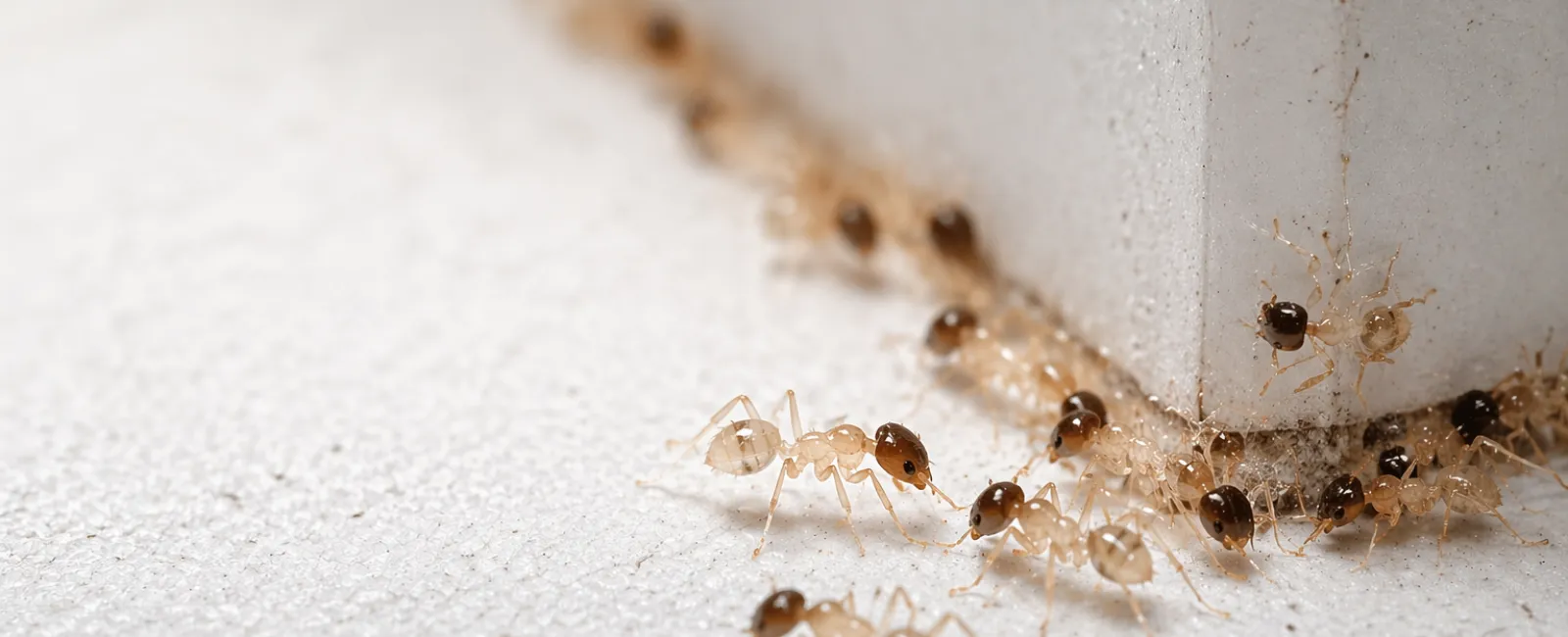
Ghost ants (Tapinoma melanocephalum) are a tropical species that has been established in South Florida for decades. They get their name from their appearance. Their heads and upper bodies are dark brown, but their legs and abdomens are so pale and translucent that they seem to disappear on light-colored surfaces.
Ghost ants are often confused with sugar ants, pharaoh ants, or white-footed ants. That confusion matters, because each of those species responds to different treatment methods. A pharaoh ant treatment used on a ghost ant colony can actually make the infestation worse by triggering the colony to split and spread throughout the home.
How Do You Know If You Have Ghost Ants?
A few signs give ghost ants away:
- Tiny, partly invisible ants — roughly one-sixteenth of an inch long, with a dark head and a pale, nearly see-through body. From across the room, a moving ghost ant looks almost like a floating dot.
- Narrow trails along edges — ghost ants travel in thin, orderly lines along grout seams, caulk, baseboards, and countertop edges.
- Activity in wet rooms — you will usually find them in kitchens, bathrooms, laundry rooms, and around screened lanais or pool enclosures.
- A faint coconut-like smell when crushed — some homeowners describe it as rotten coconut. This is one of the clearest ghost ant tells.
- Ants in potted plants — check the soil of any indoor or lanai plants. Ghost ants frequently nest there and trail into the home from outside.
If the ants you are seeing are larger, clearly black, or leaving piles of sawdust near wooden structures, you are likely dealing with carpenter ants rather than ghost ants. See our guide to signs you may be dealing with an ant infestation for a broader breakdown.
Why Ghost Ants Are So Common in Broward County
Broward County is close to a perfect environment for ghost ants. They need moisture, warmth, and access to sweet or greasy food. South Florida provides all three year-round, which is why homeowners in Coral Springs, Parkland, Cooper City, Coconut Creek, Pembroke Pines, Fort Lauderdale, Hollywood, and Miramar deal with ghost ants across every season.
Ghost ants also form what entomologists call polydomous colonies. That means a single colony splits itself into many smaller satellite nests connected by scent trails. One colony might have nests inside a kitchen wall, under the dishwasher, in a potted plant on the lanai, and in a mulch bed near the driveway, all cooperating as one unit. This is the reason a single-spot treatment almost never solves a ghost ant problem.
Why Ghost Ants Are So Hard to Get Rid Of
Here is what most people miss: the trail you see on your counter is a tiny fraction of the infestation. The rest of the colony is hidden inside walls, under mulch, in soil, and in multiple small satellite nests spread across your home and yard.
Most homeowners handle ghost ants the same way. They grab a can of spray and kill the trail they can see. It feels satisfying, and it does kill a few hundred ants. Then the problem gets worse.
The reason is called colony budding. When ghost ants detect a chemical threat, the colony splits into multiple smaller colonies, each with its own queen, and disperses to new nesting sites throughout the home. You start with one infestation and end up with three or four.
DIY methods that tend to fail against ghost ants include:
- Contact sprays — kill only visible workers and trigger colony budding
- Vinegar and essential oil sprays — disrupt trails temporarily but never reach the nests
- Diatomaceous earth on countertops — rarely touches the colony, and gets tracked around the house
- Most store-bought ant baits — many are formulated for sugar or pharaoh ants and act as repellents against ghost ants
Seeing ghost ants in your kitchen or bathroom?
We offer same-day inspections in Broward County and can eliminate the infestation at the source.
Call 954-753-5021 or schedule online.
How to Get Rid of Ghost Ants
The only approach that consistently eliminates ghost ants is slow-acting bait carried back to the colony, paired with non-repellent perimeter treatment.
Step 1: Inspect before you treat. Trace trails to entry points, identify moisture sources, and map where the ants are coming from. Rushing to treatment is one of the most common reasons a ghost ant job fails.
Step 2: Use a rotating sweet and protein gel bait. Ghost ants have fluctuating food preferences. Professional-grade gel baits placed along active trails and rotated between sweet and protein formulations will match what the colony wants at the time.
Step 3: Treat the perimeter with a non-repellent product. A perimeter treatment using a non-repellent product at the foundation, landscape beds, and entry points will not trigger the budding response. The colony stays intact long enough for the bait to collapse it.
Step 4: Fix moisture and entry points. Repair leaks, move mulch back at least twelve inches from the foundation, trim branches and shrubs off the home, and seal gaps around pipes, vents, and door sweeps.
Step 5: Follow up in ten to fourteen days. Ghost ant colonies have overlapping generations. A single treatment rarely finishes the job. A follow-up catches surviving satellite colonies before they rebuild.
South Florida's Climate Makes Ghost Ants a Year-Round Problem
Florida's warm, humid climate is ideal for ghost ant activity. These ants thrive in temperatures between 70 and 85 degrees Fahrenheit, which describes most of Broward County for the majority of the year. Unlike seasonal pests, ghost ant pressure in South Florida never really lets up. That is why one-time treatments almost always fail here long term, and why ongoing perimeter protection is the only thing that reliably keeps them out.
When to Call a Professional
A small, contained ghost ant trail can sometimes be handled with the right gel bait at home. It is time to call a professional when:
- The trail has been active for more than two to three weeks despite baiting
- You are seeing ghost ants in multiple rooms or on multiple floors
- You have already tried spraying and the problem got worse
- You are seeing ghost ants inside electrical boxes, appliances, or walls
- You rent or manage a condo or HOA property where the infestation is crossing between units
Take Action Before It Spreads
Ghost ant colonies grow quickly, and the longer they are established in your home, the harder they are to remove. One missed week can mean a new satellite colony on the other side of the house. The earlier you address them, the easier the treatment becomes.
At Greg's Aggressive Pest Solutions, we deal with every common South Florida ant, and ghost ants are at the top of the list. Our licensed technicians have been eliminating them from Broward County homes for over thirty-two years. We know where they nest, how they travel, and how to end the infestation at the source rather than just knocking back what you can see.
If you are seeing signs of ghost ants in your home, schedule your inspection online or give us a call at 954-753-5021. Same-day and next-day appointments are available, and every service is backed by our satisfaction guarantee.