
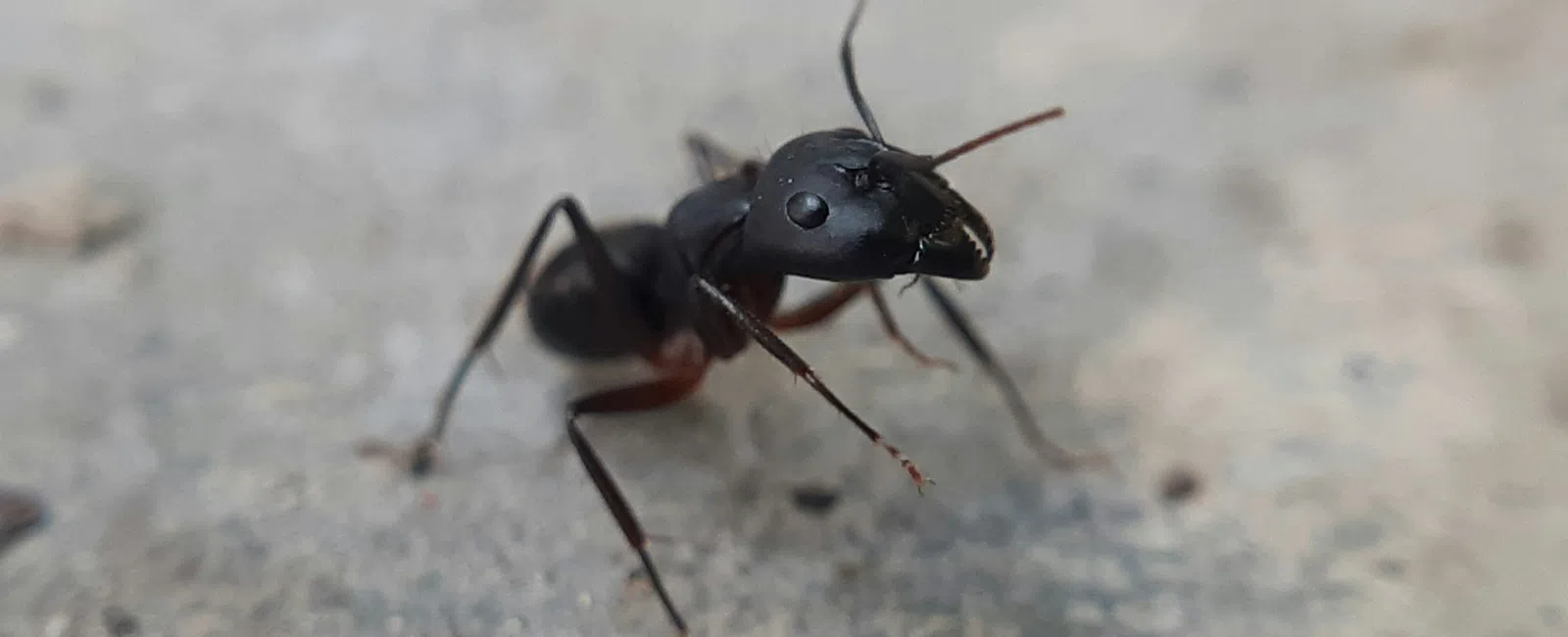
Carpenter ants do not eat wood. They chew through it to hollow out nesting galleries and push the shavings back out, which means the damage accumulates without the ants ever gaining a meal from it. That single behavior explains why the first evidence most Broward County homeowners find is a small pile of what looks like sawdust rather than a visible insect.
The species we deal with most across South Florida is the Florida carpenter ant, Camponotus floridanus, along with its close relative Camponotus tortuganus. Both are common in Broward County, both nest in structures, and both are drawn to wood that has already been softened by moisture.
How to Identify a Florida Carpenter Ant
- They are large. Workers run roughly 5.5 to 11 millimeters, noticeably bigger than the ghost ants and sugar ants people usually see in kitchens.
- Workers vary in size within the same colony, so you will find small and large individuals travelling the same trail.
- Florida carpenter ants are bicolored, with a reddish-orange head and thorax against a black abdomen.
- They forage at night, with activity climbing after dusk and peaking in the hours after dark.
- They move in loose, wandering trails rather than the tight columns sugar ants form.
The nighttime foraging is what delays most calls. Homeowners see a handful of large ants during the day and assume the problem is minor, while the colony does its actual work after the lights go out.
Carpenter Ants Compared to Termites
Both hollow out wood and both produce winged swarmers, so the two get confused constantly. The physical differences are visible without magnification.
| Carpenter Ants | Termites | |
|---|---|---|
| Waist | Pinched and narrow | Broad and straight-sided |
| Antennae | Bent at an elbow | Straight and beaded |
| Wings on swarmers | Front pair longer than back pair | All four the same length |
| Inside the galleries | Clean and smooth, shavings pushed out | Packed with soil and mud |
| Relationship to wood | Excavated for nesting only | Consumed as food |
Identification decides the treatment, because the two respond to completely different approaches. Sorting out flying termites and carpenter ants matters most during swarm season, when both send winged reproductives out of the nest at the same time of year.
Signs of Carpenter Ants in a South Florida Home
- Frass, which is the sawdust-like shavings expelled from nest openings. Carpenter ant frass contains fragments of dead insects mixed into the wood shavings, which distinguishes it from ordinary sawdust.
- Small, clean slit openings in wood surfaces, baseboards or window frames where the shavings are being pushed out.
- Large ants active indoors after dark, particularly in kitchens, bathrooms and around window frames.
- A faint rustling inside wall voids, audible in quiet rooms at night when a colony is well established.
- Winged swarmers appearing indoors, which indicates a mature colony rather than a few foragers wandering in.
- Wood that sounds hollow when tapped, or trim that gives under light pressure.
Where They Nest, and Why Moisture Decides
Florida carpenter ants rarely start in sound, dry lumber. They target wood that decay or persistent damp has already softened, which makes moisture the condition that determines whether a structure becomes a nesting site.
The locations that produce colonies in Broward County homes include wall voids behind leaking plumbing, wood framing around windows and doors that takes on water, hollow-core doors, attic sheathing under roof leaks, fascia and soffit boards, wood in contact with soil, and the framing near AC condensate lines that discharge against the structure.
Outdoors, they nest in tree cavities, dead limbs, palm fronds, stumps, firewood piles and landscape timbers. A colony frequently maintains a parent nest outside and one or more satellite nests inside the house, which is why treating what you find indoors rarely ends the problem. The reproductive center of the colony is often still sitting in a tree in the yard, and the conditions that attract ant colonies to your yard are the same ones feeding the indoor satellites.
Why Spraying the Trail Does Not Work
A contact spray kills the foragers crossing the counter, and foragers represent a small fraction of the colony. The queen, the brood and the majority of workers stay inside the galleries, unaffected, and replacement foragers appear within days.
Repellent products make the situation worse in a specific way. Carpenter ant colonies respond to chemical pressure by budding, meaning they split and relocate portions of the colony to new sites. One nest becomes several, spread further through the structure and harder to locate. This is the mechanism behind ants coming back after spraying, and it is the reason retail sprays so often precede a worse infestation rather than a resolved one.
How We Treat Carpenter Ants
Our process runs in three stages, and the inspection matters more than any product we apply.
- We begin with a detailed inspection of the home and property, locating active trails, nesting areas and entry points while assessing the full scope of the infestation. Carpenter ants leave a trail back to the nest if you follow them at the right hour, and that is where the treatment needs to land.
- From there we apply professional-grade products that are safe for your family and pets once dry. Depending on what the inspection turns up, that can involve gel baits, granular treatments, perimeter applications, or a combination designed to reach the colony at its source rather than the workers on the surface.
- We finish with follow-up visits to monitor progress, reapply where needed and confirm the colony is gone. That stage also covers sealing entry points and addressing the moisture problems that made the wood attractive in the first place, since a repaired leak does more for long-term control than any product we carry.
Carpenter ants fall under the ants covered by our monthly pest control service, and if covered pests turn up between scheduled visits, we return and treat the area again at no additional charge.
When to Call Us
Frass accumulating in the same spot, large ants active indoors after dark, or winged swarmers inside the house all indicate an established colony rather than incidental foragers. Structural wood that sounds hollow or flexes under pressure means the excavation has been underway for some time and the inspection should happen sooner rather than later.
We have treated Broward County homes since 1993, our technicians are licensed and trained on Florida species specifically, and we schedule appointments within 24 hours. Our carpenter ant control starts with finding the nest, because everything else is guesswork until we do.
Call 954-753-5021 to schedule an inspection.