
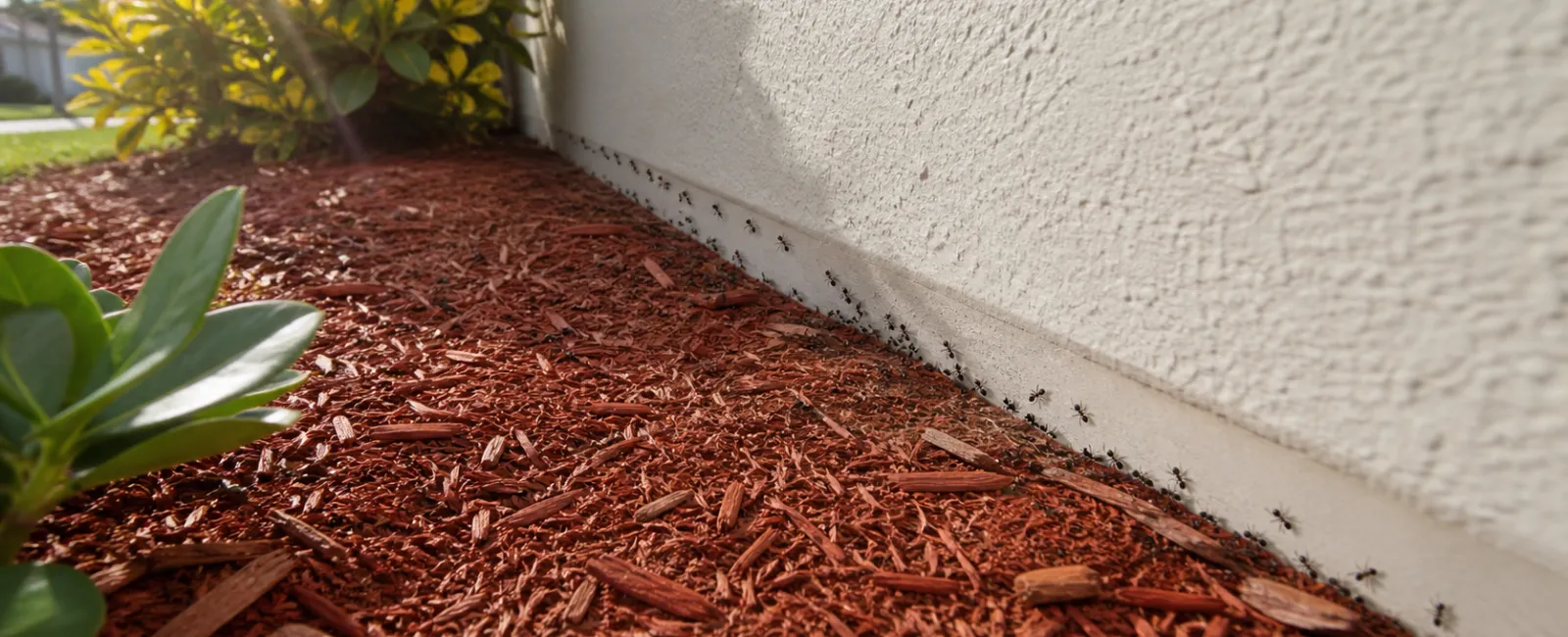
Why Ants Keep Coming Back After Spraying in South Florida Homes
If you keep seeing ants after spraying your kitchen, bathroom, baseboards, or patio, you are not alone. This is one of the most common pest problems homeowners deal with in South Florida.
Spray may kill the ants you see, but it usually does not solve the real problem. In many cases, spraying can actually make ant activity worse, especially with common South Florida ants like ghost ants.
The reason is simple: most ant problems are not just surface-level trails. They are active colonies hidden in walls, mulch, soil, landscaping, plumbing gaps, and other protected areas around the home.
This guide explains why ants keep coming back after spraying, why DIY ant control often fails, and what actually works to eliminate the colony.
Why Spraying Ants Feels Like It Works
Spraying ants gives immediate results.
You see a trail of ants. You spray them. The trail disappears.
That makes it feel like the problem is gone. But in most cases, you only killed the worker ants that were visible at that moment.
Those workers are only a small part of the colony. The queen, nesting sites, and most of the ants are usually still hidden nearby.
That is why ants often return within a few days. Sometimes they come back in the same spot. Other times, they appear in a different room.
The Colony Is Usually Still Alive
The biggest reason ants keep coming back after spraying is that the colony was never eliminated.
Most ant colonies are built around one or more queens. As long as the queen survives, the colony can keep producing new workers.
The ants you see on your counter or along your baseboard are usually foragers. Their job is to search for food and water, then lead other ants back to the source.
The actual nest may be hidden:
- Inside a wall void
- Under a slab
- In a mulch bed
- Around plumbing lines
- In a potted plant
- Near a window or door frame
- Under landscaping close to the foundation
Until the colony is treated correctly, the ants will keep returning.
Spraying Can Make Some Ant Problems Worse
This is especially important in South Florida.
Certain ant species respond poorly to contact sprays. Instead of eliminating the colony, the spray creates stress. When that happens, the colony may split into multiple smaller colonies.
This is called colony budding.
Ghost ants are one of the best examples. They are extremely common in Broward County and are known for spreading when treated incorrectly.
If you are seeing tiny, pale ants around your kitchen, bathroom, sink, or baseboards, you may be dealing with ghost ants. You can read our full guide here:
Ghost Ants in South Florida: Broward County Guide
When colony budding happens, you may notice:
- Ants appearing in new rooms
- Multiple trails instead of one
- Activity moving from the kitchen to the bathroom
- Ants returning faster after each treatment
- The problem feeling worse than before
This is why spraying every ant trail is usually not the best long-term solution.
Why Ants Are So Common in Broward County
South Florida gives ants almost everything they need: warmth, moisture, food, and shelter. In Broward County, that means ant activity can happen almost year-round.
Homes in Coral Springs, Parkland, Coconut Creek, Pembroke Pines, Fort Lauderdale, Hollywood, and Miramar deal with ant pressure through every season because there is no true winter shutdown.
Common conditions that attract ants include:
- Moisture around sinks, bathrooms, and laundry rooms
- Crumbs and food residue in kitchens
- Pet food left out overnight
- Landscaping and mulch touching the home
- Gaps around windows, doors, and plumbing
- Tree branches and shrubs touching the structure
Even a clean home can get ants. They only need a small food or water source to begin trailing inside.
Common DIY Mistakes That Keep Ants Coming Back
Most homeowners are not failing because they are doing nothing. They are usually using the wrong approach.
Here are the most common mistakes.
Mistake 1: Using Contact Spray on Every Trail
Contact sprays kill ants quickly, but they do not reach the colony.
They also leave behind chemical residue that can disrupt trails and cause ants to move to new areas. With certain species, this disruption can cause the colony to split and spread.
Spray may provide temporary relief, but it should not be the main strategy for most indoor ant problems.
Mistake 2: Using the Wrong Bait
Not all ant baits work for every ant species.
Some ants are looking for sugar. Some are looking for protein. Some change preferences depending on the season, colony needs, and available food sources.
If the bait does not match what the ants want, they may ignore it completely.
This is one reason store-bought ant bait stations often produce inconsistent results. The product may not be wrong, but it may not be right for that specific colony.
Mistake 3: Cleaning Away Bait Too Soon
Ant bait takes time.
The goal is not to kill the ants instantly. The goal is for the ants to carry the bait back to the colony and share it.
If the bait is removed too early, the process stops before it reaches the nest.
This can be frustrating because baiting may temporarily increase visible ant activity. But that activity often means the ants are feeding on the bait, which is necessary for the treatment to work.
Mistake 4: Treating Only Inside the Home
Many ant colonies start outside.
In South Florida homes, ants often nest in:
- Mulch beds
- Soil near the foundation
- Potted plants
- Irrigation areas
- Tree roots
- Cracks in patios or walkways
- Wall voids connected to exterior entry points
If the outside source is not addressed, ants can continue entering the home even after indoor trails are treated.
That is why a full ant control plan usually includes both interior treatment and exterior perimeter protection.
What Actually Works to Get Rid of Ants
The best way to get rid of ants is to target the colony, not just the ants you see.
A proper ant treatment plan usually includes inspection, species identification, baiting, non-repellent treatment, and follow-up.
Step 1: Identify the Ant Species
Species identification matters.
Ghost ants, carpenter ants, pharaoh ants, white-footed ants, and fire ants all behave differently. A treatment that works for one species may not work for another.
For example, ghost ants are tiny and often trail indoors around kitchens and bathrooms. Carpenter ants are larger and may be connected to moisture-damaged wood.
Before treating, you need to know what type of ant you are dealing with.
Step 2: Find the Source
The visible trail is only a clue.
A technician will look for where the ants are coming from, where they are going, and what conditions are supporting the colony.
This may include checking:
- Window frames
- Plumbing penetrations
- Baseboards
- Cabinet voids
- Mulch beds
- Trees and shrubs
- Potted plants
- Moisture-prone areas
The goal is to find the source, not just treat the symptom.
Step 3: Use the Right Bait
Slow-acting bait is often the most effective tool for indoor ant problems.
The ants carry the bait back to the colony and share it with other ants. Over time, the treatment can reach the queen and collapse the colony.
The key is placement and bait selection. The bait needs to be placed where ants are already active, and it needs to match what they are feeding on.
Step 4: Use a Non-Repellent Perimeter Treatment
A non-repellent product works differently than a regular spray.
Instead of causing ants to avoid the area, it allows them to pass through the treatment and transfer it back to the colony.
This is especially useful around:
- Foundations
- Entry points
- Landscape beds
- Patio edges
- Door thresholds
- Utility openings
For South Florida homes, this exterior step is important because many ant problems begin outside and move indoors.
Step 5: Follow Up
Ant control is not always a one-visit fix.
Some colonies have multiple nesting sites. Others have overlapping generations. Follow-up service helps catch remaining activity before the colony rebuilds.
This is especially important with ghost ants and other species that can spread through multiple areas of the home.
How to Reduce Ant Activity Between Treatments
Professional treatment is the most reliable solution, but there are steps homeowners can take to reduce ant pressure.
You can help by:
- Wiping down counters at night
- Cleaning under appliances
- Keeping pet food sealed
- Fixing leaky pipes and dripping faucets
- Taking trash out regularly
- Moving mulch away from the foundation
- Trimming shrubs and branches off the house
- Sealing gaps around pipes, doors, and windows
These steps will not eliminate an established colony by themselves, but they can make your home less attractive and help treatment work better.
When to Call a Professional
It is time to call a professional if:
- Ants keep coming back after spraying
- You are seeing ants in multiple rooms
- The trail has lasted more than two weeks
- You are seeing tiny ants around sinks or bathrooms
- You already tried bait and it did not work
- Activity got worse after using spray
Ant infestations often look simple, but the source is usually hidden.
The longer the colony stays active, the more difficult it becomes to remove.
Take Action Before the Colony Spreads
If ants keep returning after spraying, the colony is still active somewhere nearby.
The best solution is not to keep spraying every trail. The best solution is to identify the species, find the source, and use a treatment strategy that reaches the colony.
At Greg's Aggressive Pest Solutions, we've been treating ant infestations across Broward County for over 30 years. We handle common South Florida ants, including ghost ants, carpenter ants, fire ants, and other household ant species.
We focus on eliminating the source of the problem instead of just knocking down visible activity.
Call 954-753-5021 or schedule service online.
Same-day and next-day appointments are available. Click here to schedule service.
FAQ
Why do ants come back after I spray them?
Ants come back because spraying usually kills only the visible worker ants. The colony and queen are often still hidden nearby, which allows the infestation to continue.
Can spraying ants make the problem worse?
Yes. Some ant species, including ghost ants, may split into multiple colonies when stressed by certain sprays. This can cause ants to appear in new rooms or spread throughout the home.
Is bait better than spray for ants?
In many cases, yes. Bait is designed to be carried back to the colony, which makes it more effective for long-term ant control than simply killing the ants you can see.
Why do ants keep showing up in my kitchen?
Kitchens provide food, water, warmth, and hiding spots. Even small crumbs, grease residue, pet food, or moisture under the sink can attract ants.
Do ants go away on their own?
Usually, no. Ant colonies tend to grow if food, moisture, and shelter are available. Temporary activity may slow down, but the colony often remains active nearby.