
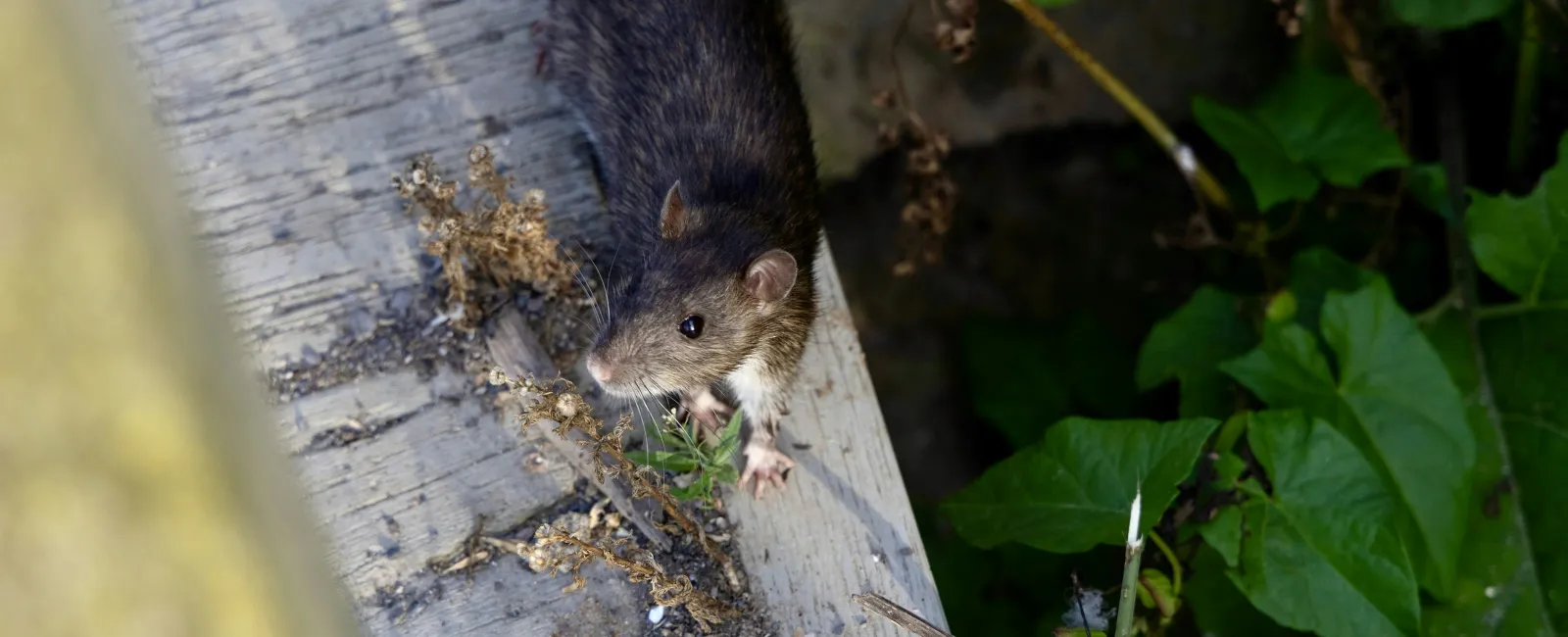
What Do Rat Droppings Look Like?
Rat droppings are typically dark brown to black, shiny when fresh, and dull or gray when older. They are shaped like a capsule or a large grain of rice, roughly half an inch to three-quarters of an inch long. That is about the size of a raisin, which makes them noticeably larger than what a mouse leaves behind.
Fresh rat feces tend to have a slight sheen and a soft texture. If the droppings look chalky, crumble when touched, or have faded to gray, they are older. That is useful information: older droppings suggest the infestation may have been going on longer than you realized, even if you are only noticing it now.
Rat Droppings vs. Mouse Droppings: How To Tell the Difference
The easiest way to tell them apart is by size. Rat poop is roughly the size of an olive pit, blunt at both ends, and cylindrical. Mouse droppings are much smaller, closer to the size of a grain of rice, with pointed tips. If what you found is more than half an inch long, you are almost certainly dealing with rats rather than mice.
Color is not a reliable way to distinguish the two since both species produce dark brown to black droppings. Size and shape are your best clues every time.
Where Are You Most Likely to Find Rat Droppings?
Rats are creatures of habit. They tend to stick to the same travel routes and feeding spots, which means droppings tend to cluster in specific areas rather than scattered randomly throughout a home. The most common spots include kitchen cabinets and pantry shelves, especially behind appliances or near stored food. You will also frequently find rat feces along baseboards and walls, since rats hug vertical surfaces while moving.
Attics and crawl spaces are another favorite. Roof rats in particular are excellent climbers and love to nest up high. Garages with stored boxes or clutter, under sinks, near garbage cans, and inside utility closets are also common discovery points.
If you are finding droppings in more than one location, that is a strong indicator of an active rat infestation rather than a single stray visitor passing through.
Are Rat Droppings Dangerous?
Yes, and they deserve to be taken seriously.
Rat feces can carry several pathogens that pose real health risks to people and pets. Hantavirus is one of the most serious concerns: a potentially fatal respiratory illness that spreads through contact with rat urine, droppings, or nesting materials. Leptospirosis is a bacterial infection that can affect the kidneys and liver. Salmonellosis can be contracted by consuming food or water contaminated with rat feces. Rat-bite fever, despite the name, can also be transmitted through contact with an infected rat's secretions.
You do not even have to touch rat droppings directly to be at risk. Simply disturbing dry droppings can release particles into the air. This is exactly why cleanup requires a deliberate process rather than just sweeping them up with a broom.
How To Safely Clean Up Rat Droppings
Resist the urge to grab a paper towel and wipe the droppings away. That approach can aerosolize the very particles you are trying to eliminate.
Start by airing out the area. Open windows and doors for at least 30 minutes before you go in, and skip the fan since airflow can spread particles further. Put on rubber or plastic gloves, an N95 mask or better, and eye protection before you get close to the droppings.
Spray the affected area with a disinfectant solution, such as one and a half cups of bleach mixed into a gallon of water, and let it soak for five minutes. Then wipe up with paper towels rather than sweeping or vacuuming. Double-bag all waste and get it out of the house right away. Disinfect the surrounding surface and wash your hands thoroughly even if you wore gloves the entire time.
One important note: if you are dealing with a large infestation or droppings in an attic or crawl space, professional remediation is the safer call. The scale and confined spaces make DIY cleanup genuinely risky.
Signs You Have an Active Rat Infestation
Finding droppings alone does not always confirm rats are currently living in your home. Fresh droppings are your best indicator: they will be shiny, dark brown, and slightly soft. Older ones are gray and crumble easily.
Beyond the rat poop itself, look for gnaw marks on food packaging, wood, or wiring. Grease marks along baseboards are left by rats rubbing their oily fur as they travel the same paths repeatedly. Scratching or scurrying sounds at night, especially inside walls or the attic, are a telltale sign. Shredded paper, fabric, or insulation tucked into hidden corners points to active nesting. A musky or ammonia-like odor in enclosed spaces is another red flag.
If two or more of these signs are present alongside rat feces, it is time to act. Rats reproduce fast. A single pair can produce up to 2,000 descendants in a year under favorable conditions. Waiting and hoping the problem resolves itself is not a winning strategy.
What To Do If You Have a Rat Problem in South Florida
South Florida's warm climate, dense neighborhoods, and year-round food sources make it a prime environment for rats. The Norway rat and the roof rat are both common throughout Broward County, and both can squeeze into a home through a gap as small as half an inch.
At Greg's Aggressive Pest Solutions, our licensed technicians have been helping Broward County homeowners identify and eliminate rodent problems for over 32 years. We do not just set a few traps and call it a day. Our rodent control process includes a full inspection, targeted treatments, and exclusion work to keep rats from finding their way back in.
Found rat droppings in your home? Do not wait. Schedule a rodent inspection today or call us at 954-753-5021. Same-day and next-day appointments are available, and every service is backed by our satisfaction guarantee.